
It’s Not a Learning Recession. It’s an Educational Crisis.
I’m a public school rookie with only about a half year of classroom experience teaching oral communication and English language arts. But it doesn’t take an educational veteran or a terminal degree to see the unmistakable reality.
In Arkansas and beyond, we are graduating high school students who simply cannot read.
Thanks for reading! Subscribe for free to receive new posts and support my work.Subscribe
The numbers are staggering.
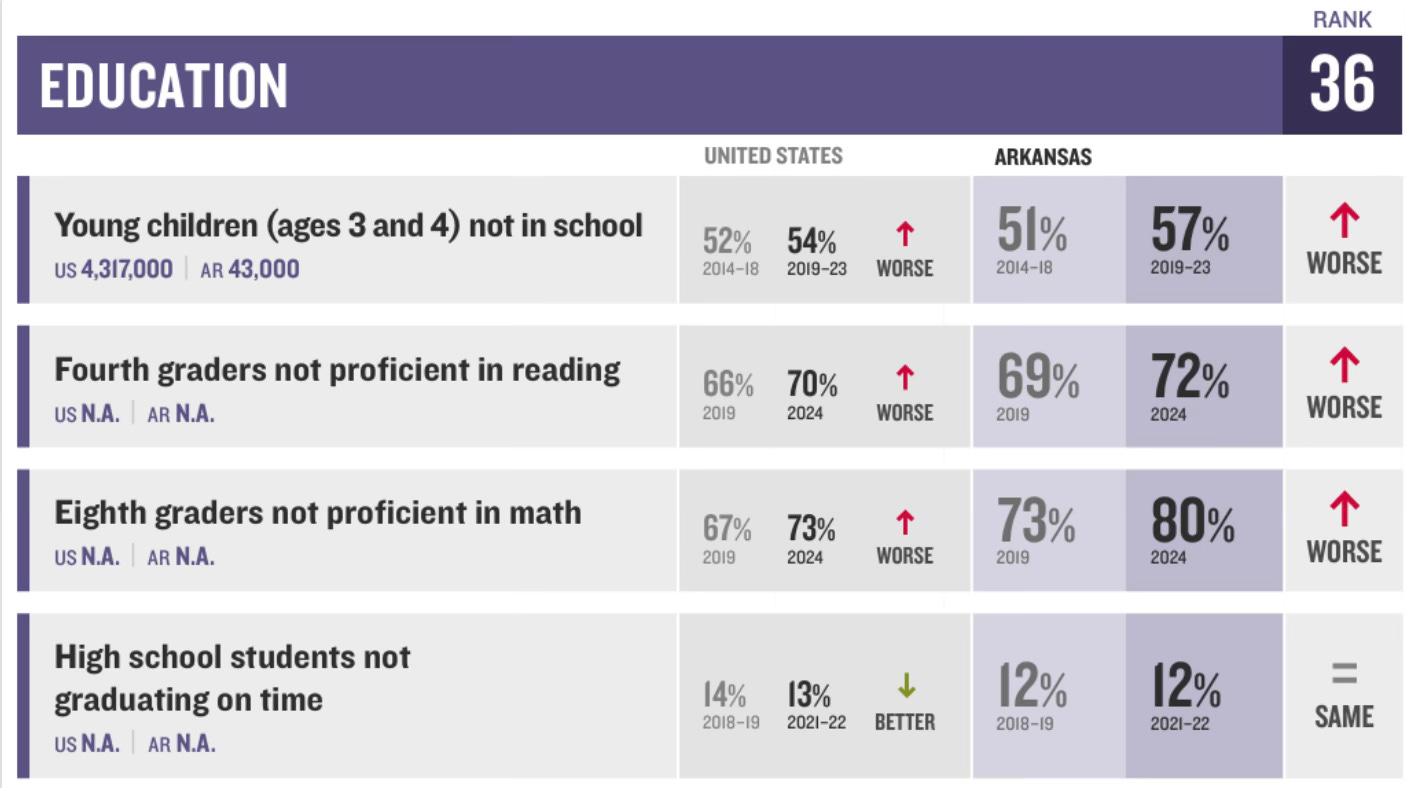
In 2024, fourth-grade reading proficiency in Arkansas measured 28 percent. Equally alarming: the state’s scores are below the abysmal 35 percent national proficiency average. Said another way, 62 percent of Arkansas fourth-grade students read below proficiency.
The state is taking on some new initiatives to reverse the trend, not the least of which is the Arkansas LEARNS Act which mandates academic training in the “Science of Reading” and intensive support for students not reading at grade level by the third grade.
I’m near the completion of the Science of Reading curriculum, and I’m at a loss for how this makes much difference moving forward.
The state has also implemented new fourth-grade promotion standards for students who perform below proficiency. That’s not a bad move.
Incidentally, the reports for math and science proficiency are no better.
We could debate what’s caused all this, but that’s for another day. It’s not one reason, or even two, but rather a Perfect Storm of academic, cultural, and community failures over a decade. This is not a problem – it’s a crisis with a potential for monumental impact in the not-distant future. State legislators should be running around like their pants are on fire over all this.
From the viewpoint of someone who is still essentially an outsider looking in, here are four thoughts toward reversing the trend.
•Teacher salaries should be doubled. Yes, I said doubled. Public school teaching is a profession with enormous responsibilities. Let’s make entering the field a highly competitive process, ensuring those who lead the classroom are the best, the brightest, and the hardest working. Do you want a doctor who barely made it through medical school and just bides her time for paycheck? Not any more than you want a teacher who shows up and gives anything less than 110 percent for your children and grandchildren. Even as a long-term sub, I put in 65-70 hours a week. I could never bear calculating the hourly wage.
•More high-impact tutoring programs for early intervention. Maybe we’re headed in that direction. It’s enormously more difficult correcting these challenges with a tenth grader than a second grader. Tutors should be highly trained specialists who understand dyslexia and other barriers to reading.
•Less, and not more, dependence on technology in the classroom. Technology is an amazing supplement for what teachers can accomplish. We understand the science of reading (how the brain does this) better every day. We also must recognize the vastness of literacy as an art form. Artificial intelligence is an ELA teacher’s front-line enemy. We need fewer hours on the laptop and more time with pencil, paper, and book in hand. This is not just a nostalgic wish for the old ways. Literacy proficiency is progressive, and students must walk before they can run.
•We must do what we can to create a stronger culture between schools and families. It seems we’ve reached a point where these two are frequently more at odds than on a narrow path. That means more time-consuming communication between teachers and parents (just another reason for a higher salary). It means more parent involvement at school and at home. It means active parent-teacher associations that administrators engage with and include.
We’ve buried our heads in the sand long enough. The serious nature of all this can’t be overstated.